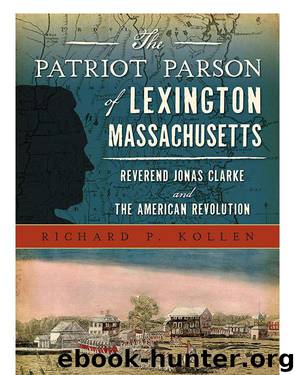
Patriot Parson of Lexington, Massachusetts, The: Reverend Jonas Clarke and the American Revolution (Military) by Kollen Richard P
Author:Kollen, Richard P. [Kollen, Richard P.]
Language: eng
Format: epub
Publisher: Arcadia Publishing Inc.
Published: 2016-02-29T05:00:00+00:00
Paul Revere, 1768, by John Singleton Copley. Museum of Fine Arts, Boston.
Meanwhile, General Gage tried his best to avoid violent conflict. But earlier in 1774, while on a sabbatical in England, he had boasted to the king that he could subdue Massachusetts rebels with a mere four regiments. Now the general understood how mistaken he had been. His army of three thousand was confined to Boston, a peninsula connected to the mainland by one slim, fortified neck of land. The surrounding countryside, the most densely populated in North America, had become increasingly hostile. Gage’s reports to Lord Dartmouth, his immediate superior in England, voiced ever more alarm. The general recommended an overwhelming force be sent to awe the countryside into submission. Absent this force, the only alternative seemed to be to calm the public’s angry mood with the Coercive Acts’ suspension. His present army was too small to intimidate the opposition yet too large not to provoke it. 51 In a private letter dated November 2 to his longtime friend Lord Barrington, secretary of war, a position subordinate to Dartmouth, an exasperated Gage wrote, “If you think ten thousand men sufficient, send twenty, if one million is thought enough, give two; you will save both blood and treasure in the end.” 52
Such talk convinced the British ministry that the apprehensive Gage showed disturbing signs of weakness, seemingly cowed by mere country rabble who surely would scatter at the sound of musket fire. Had not Gage himself said the same to the king? Dartmouth recommended that the general arrest two or three Whig leaders, but Gage understood that the local leadership did not reside with a few at the top. Arresting two or three—Hancock, Adams, Warren—would only make them martyrs, while creating new leaders and setting off armed hostilities. 53 Further compounding Gage’s dilemma, penned up in Boston, he commanded an army that also considered him weak because he treated the locals with fairness and respect.
Salem’s tenure as the seat of government all but ended once Gage dissolved the General Court on June 17. Without its colonial legislature, Massachusetts had been relying on town meetings, county conventions and Committees of Correspondence for direction. On the day of the powder alarm, Gage issued writs for the House’s next session in October. But he had to rescind those orders in the face of the country folk’s outraged response to the seizure of their powder. Despite the cancelation, town meetings elected delegates to attend the General Court’s assembly at Salem on October 5. When the governor failed to appear, the assembly reconstituted itself into a Provincial Congress, elected John Hancock its president and prepared to conduct business as the sovereign government of Massachusetts. It then adjourned to Concord to hold sessions in the courthouse there, beginning on October 11.
On September 15, Reverend Clarke noted militia drilling on the Common—“Showing arms”—as Lexington’s daily life began to take on a more martial aspect. Captain Thaddeus Bowman led a poorly equipped and relatively inexperienced collection of would-be soldiers.
Download
This site does not store any files on its server. We only index and link to content provided by other sites. Please contact the content providers to delete copyright contents if any and email us, we'll remove relevant links or contents immediately.
Shoot Sexy by Ryan Armbrust(17811)
Portrait Mastery in Black & White: Learn the Signature Style of a Legendary Photographer by Tim Kelly(17069)
Adobe Camera Raw For Digital Photographers Only by Rob Sheppard(17047)
Photographically Speaking: A Deeper Look at Creating Stronger Images (Eva Spring's Library) by David duChemin(16752)
Bombshells: Glamour Girls of a Lifetime by Sullivan Steve(14152)
Art Nude Photography Explained: How to Photograph and Understand Great Art Nude Images by Simon Walden(13109)
Perfect Rhythm by Jae(5497)
Pillow Thoughts by Courtney Peppernell(4356)
The Book of Joy by Dalai Lama(4059)
Good by S. Walden(3634)
The Pixar Touch by David A. Price(3495)
A Dictionary of Sociology by Unknown(3125)
Fantastic Beasts: The Crimes of Grindelwald by J. K. Rowling(3095)
Stacked Decks by The Rotenberg Collection(2941)
Humans of New York by Brandon Stanton(2924)
Read This If You Want to Take Great Photographs by Carroll Henry(2750)
On Photography by Susan Sontag(2687)
Insomniac City by Bill Hayes(2609)
Photographic Guide to the Birds of Indonesia by Strange Morten;(2581)
